
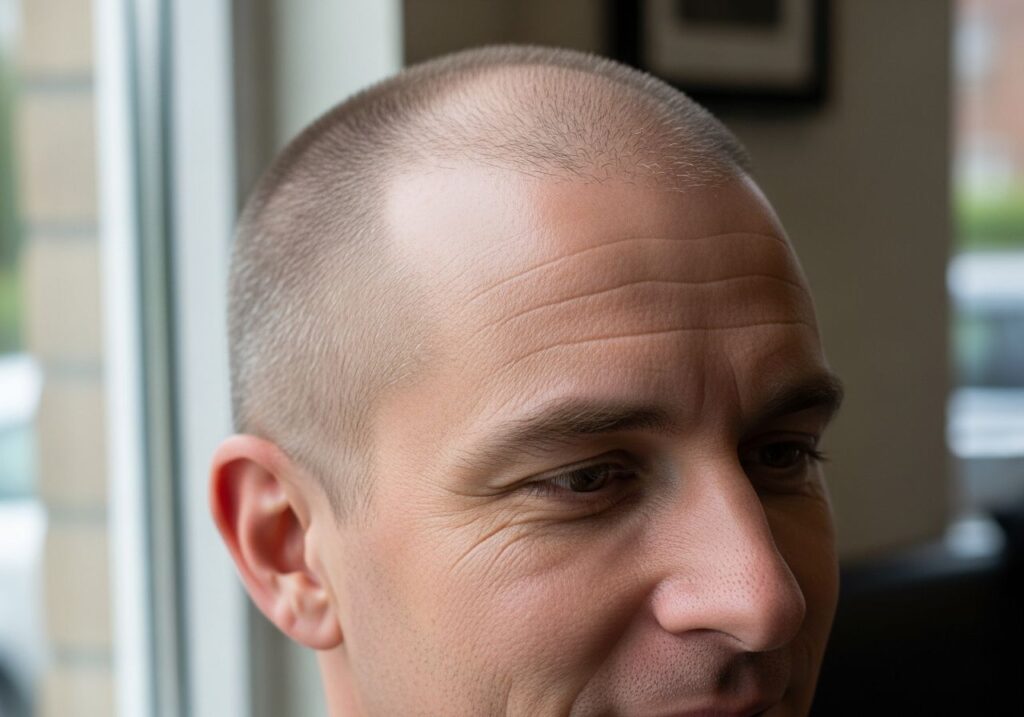
I typically see men reach full density in two to three SMP sessions. The sessions are spaced seven to fourteen days apart so I can assess how the pigment settles before adding more. After the final session, full healing takes about a month, when the true, settled result becomes visible.
You’ve done the research and you’re past the point of wondering whether scalp micropigmentation works. What you actually want to know is simpler: how many appointments, how far apart, and when do you get to see the finished result? Here’s the honest breakdown of what a male density treatment actually involves, session by session.
Most men need between two and three SMP sessions to reach full density, and each one has a specific job to do. This isn’t a single visit and done. It’s a layered process, built deliberately over several weeks so your scalp can heal and your practitioner can judge how the pigment is settling before adding more.
What happens in each session
Session one lays the groundwork. Your practitioner maps a hairline and establishes the overall pattern using a lighter dot density, typically around 40 dots per square centimetre. This first pass is intentionally conservative. It’s far easier to add pigment in a later session than to lighten an area that’s gone too dark too soon.
Session two is where density really builds. Once the initial pigment has healed and settled, your practitioner returns to increase dot density, often pushing towards 60 to 80 dots per square centimetre, filling in gaps and deepening the illusion of a fuller hairline. This is usually the session where men start seeing the result they came in for.
A third session isn’t always necessary, but for many men it’s what takes the result from good to genuinely convincing. This final pass corrects any patchiness, adds density to areas that faded slightly during healing, and sharpens the hairline for a more natural, three-dimensional look. Some practitioners use a finer needle for hairline work and a slightly broader one for crown or mid-scalp density, adjusting technique zone by zone rather than treating the whole scalp the same way.
Why sessions are spaced seven to fourteen days apart
This gap isn’t arbitrary. Pigment placed at the epidermal-dermal boundary needs time to settle, and your skin needs time to shed the top layer of ink that was never meant to stay. A portion of what looks like solid colour on day one is temporary; it clears within the first few weeks as your skin’s surface renews itself.
Waiting seven to fourteen days lets your practitioner see the true healed colour, not the fresh, darker version you’ll notice straight after treatment. Going back too soon means working over pigment that hasn’t finished settling, which risks over-saturation and an unnatural, flat look. Going back too late simply delays your result without adding any benefit.
Redness typically fades within two to three days after each session, and most men are comfortable returning to normal routines well before the next appointment. Full healing after the final session takes about a month, which is when the true, settled result becomes visible.
How your practitioner decides if you need another pass
Before adding further sessions, your practitioner examines healed retention closely, not just how the scalp looks under studio lighting immediately after treatment. They’re checking for even pigment distribution, correct depth placement, and whether tone matches your natural hair colour once the healing process has run its course.
Some areas heal darker or hold pigment differently than others, particularly around scar tissue or previous transplant sites. If retention looks patchy or lighter than intended in specific zones, that’s addressed in the next session rather than starting over. This is also why photographs taken at each stage matter: comparing healed results side by side gives an objective read on where density genuinely needs building versus where it’s simply catching the light differently.
What to expect after your final session
Once your last session has healed, at around the thirty-day mark, you’re looking at your finished result. From there, this isn’t a one-and-done investment. SMP density typically holds strong for four to six years before it starts to soften, and most men return for a touch-up appointment on that kind of schedule rather than needing a full retreatment.
Sun exposure, skin type, and how oily your scalp naturally is all affect how long pigment holds its depth. Regular SPF on the scalp once healing is complete helps preserve the result for longer, and it’s a habit worth building early rather than after you notice fading. When a touch-up is needed, it’s typically a single, shorter session rather than the full multi-visit process you went through initially, since the existing pattern and density are simply refreshed rather than rebuilt.
Ready to talk it through?
Micropigment Studio in San Jose offers a personal consultation to answer your questions and recommend the right approach for you. Get in touch with Micropigment Studio to book your consultation.
Frequently Asked Questions
What happens during the first male density SMP session?
During the first session, I map the hairline and establish the overall pattern using a lighter dot density. I keep this initial pass conservative so I can assess how the pigment settles during healing. Later, I can add pigment where needed rather than making areas too dark too soon.
How far apart are male density SMP sessions?
I usually space male density SMP sessions seven to fourteen days apart. This gives your skin time to heal and allows me to assess how the pigment has settled before adding more. Returning too soon means I may be working over pigment that has not finished settling, increasing the risk of an over-saturated, flat appearance.
When will I see the final male density SMP result?
I consider the true, settled result visible after about a month of full healing following your final session. Immediately after treatment, the scalp can appear darker because some surface ink is temporary. As the skin renews itself and healing finishes, the pigment settles into its lasting appearance.
Will I need a third male density SMP session?
I do not always need a third session, but it can take the result from good to genuinely convincing. I use it to correct patchiness, add density where pigment faded slightly during healing, and sharpen the hairline. Whether it is needed depends on how the pigment has settled after earlier sessions.
How quickly can I return to my normal routine after each session?
I find that redness typically fades within two to three days after each session, and most men are comfortable returning to normal routines well before their next appointment. I still allow seven to fourteen days between sessions so I can assess healed pigment and decide where additional density is appropriate.
How long does male density SMP usually last before a touch-up?
I typically see male density SMP hold strong for four to six years before it begins to soften. When a touch-up becomes appropriate, it is usually a single, shorter session because I refresh the existing pattern and density rather than rebuilding the full treatment. Sun exposure, skin type, and scalp oiliness affect longevity.
