
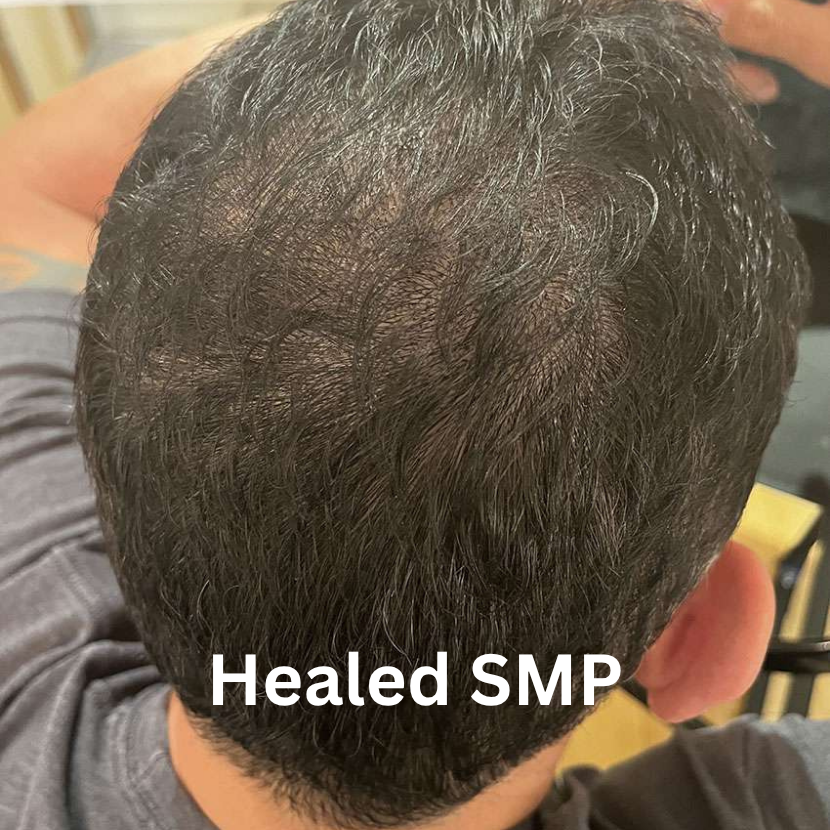
I explain that the challenge is managing contrast: dark hair makes mismatched pigment, over-dense impressions, incorrect depth, and uniform patterns more noticeable. I place impressions between existing follicles, vary their size, pressure, and spacing, and build softer pigment in layers across sessions to create dimension and a natural-looking impression of fuller hair.
You’ve noticed your hair thinning, but you’re not ready to shave your head. You want density back, not a complete transformation. This article explains how SMP density treatment works for men with dark hair, where the real technical challenges sit, and what separates a natural result from one that looks painted on.
Why dark hair changes everything about SMP density
SMP density treatment for dark hair is more technically demanding than most people realise, and contrast is the reason. When your natural hair is dark brown or black, even a slightly mismatched pigment or an over-dense application will stand out immediately against your scalp. The margin for error is smaller than it is for lighter hair colours.
The goal with a density treatment is to create the impression of fuller hair between your existing follicles, not to replace them. That means placing hundreds of small, precise impressions at the correct depth and spacing so they blend with what’s already there. With dark hair, each of those impressions is held against a high-contrast backdrop every time you step into natural light.
Pigment selection is the first critical decision. Black scalp micropigmentation pigment applied too heavily reads as a flat, artificial layer rather than a natural shadow. A skilled practitioner will typically start with a softer, slightly cooler-toned pigment and build in layers across sessions, never going fully opaque in one pass. This layering approach is what creates dimension rather than a uniform block of colour.
Contrast balance and avoiding a harsh finish
The biggest complaint from men who’ve had poor density SMP results isn’t that the colour is wrong. It’s that the overall effect looks too uniform, too deliberate. Natural hair doesn’t grow in perfectly even rows: it clusters, changes direction, and leaves irregular gaps. Good SMP density work mirrors that randomness.
With black hair scalp micropigmentation specifically, the practitioner needs to vary both the size and the pressure of each impression. Larger, darker dots placed too close together in thinning areas create a shadow that looks solid under direct light. Mixing impression sizes, some slightly lighter and some slightly smaller, breaks up that solid appearance and lets the result breathe.
Hairline work in a density treatment also needs particular care for dark-haired men. A hard, defined edge at the temple or crown where thinning is most visible will immediately signal that something artificial is present. A softened, irregular border that mirrors the natural recession pattern is far less detectable, even at close range. This is a refinement I pay close attention to during the planning stage of every density session.
Pigment depth and how it affects long-term results
Depth matters as much as colour when it comes to a dark hair density treatment. Pigment placed too superficially can heal with a blue or grey cast, which on a dark-haired client creates a visible mismatch between the implanted impressions and the warm tones of natural dark hair. Pigment placed too deep can spread slightly over time, softening the crisp edge of each impression and producing a blurred, less defined result.
The correct placement sits in the upper dermis: shallow enough to retain definition but deep enough to avoid that blue-grey healing shift. This is a calibration that comes from experience, not guesswork. It’s also why the layered, multi-session approach matters; each session allows the practitioner to assess how the pigment has settled before adding more density.
Touch-up sessions, typically twelve to eighteen months after the initial treatment, are a normal part of maintaining a density result. Dark pigments do fade more noticeably than lighter ones relative to the contrast they create, so staying on top of maintenance keeps the result looking intentional rather than neglected.
What to expect from consultation to final result
A thorough consultation for black hair scalp micropigmentation should include a close examination of your natural hair colour in different lighting conditions, a discussion of your thinning pattern, and a realistic conversation about what density SMP can and cannot do. It doesn’t reverse hair loss or add physical volume. What it does is create the visual impression of density, which for many men is exactly what they’re looking for.
Most clients with dark hair need two to three sessions spaced two to three weeks apart to build sufficient density without over-saturating any single area. The first session establishes the base tone and coverage. Subsequent sessions refine, deepen, and blend. By the final session, the result should look like your own hair at a fuller stage, not like a hair tattoo applied from the outside.
Aftercare for the first week is straightforward: avoid direct sun exposure, keep the scalp dry, and don’t apply any products to the treated area. Sun protection long-term is the single biggest factor in preserving pigment vibrancy, especially with darker tones that are more susceptible to UV-driven fading.
Frequently Asked Questions
Can SMP density treatment match very dark or black hair exactly?
A skilled practitioner can get very close, but an exact match isn’t always necessary. The goal is to create impressions that blend within the context of your hair rather than match each strand precisely. Layering pigment across multiple sessions produces a more natural integration than attempting to match a single dense tone in one pass.
How many sessions does dark hair density SMP typically require?
Most dark-haired men need two to three sessions, spaced two to three weeks apart. The layered approach prevents over-saturation and allows the practitioner to assess how the pigment heals between appointments. Rushing the process by compressing sessions tends to produce a flatter, less natural-looking result.
Will the SMP impressions look grey as they fade over time?
This is a real risk if the pigment is placed too shallowly or if an incorrect pigment formula is used. Quality SMP pigments formulated specifically for scalp work are designed to fade to a softer version of the original tone rather than shift to grey or blue. Choosing an experienced practitioner with the right pigment range significantly reduces this risk.
Does SMP density treatment work if I still have significant hair on top?
Yes, and this is exactly the scenario a density treatment is designed for. The SMP impressions are placed between your existing follicles to reduce the visible contrast between hair and scalp. The technique works with your remaining hair rather than replacing it, making it well-suited for men who want to preserve their current length and style.
How long does a dark hair density SMP result last before touch-up is needed?
Most clients return for a touch-up session every twelve to eighteen months, though this varies with sun exposure, skincare habits, and individual skin type. Darker pigments can appear to fade more noticeably against high-contrast hair, so staying consistent with maintenance appointments keeps the density result looking intentional and well-maintained.
What should I avoid during the first week after dark hair density SMP?
I advise you to avoid direct sun exposure, keep your scalp dry, and refrain from applying products to the treated area during the first week. For longer-term pigment preservation, I also emphasize sun protection, because darker tones are more susceptible to fading caused by ultraviolet exposure.
