
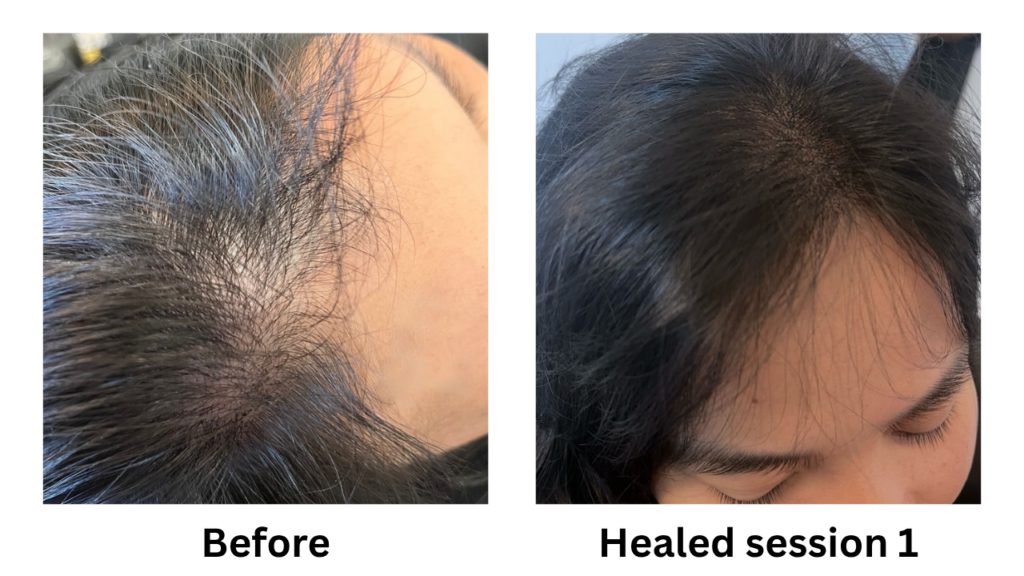
I use female density SMP to create the visual impression of fuller hair after postpartum thinning by placing precise pigment deposits between existing follicles. It does not interfere with natural regrowth, does not require shaving, and can be adjusted across sessions. I generally recommend waiting until shedding has stabilised, usually nine to twelve months postpartum.
Your hair was thick during pregnancy, and now it’s falling out in handfuls. You’re not imagining it, and you’re not alone. This article explains how scalp micropigmentation can help women dealing with postpartum hair thinning, when the timing is right to start treatment, and what combining SMP with hormonal recovery actually looks like in practice. You’ll leave with a clear decision framework, not just reassurance.
Why postpartum hair loss happens and why it hits so hard
During pregnancy, elevated oestrogen levels keep hair in its growth phase longer than usual. The result is a fuller, thicker head of hair that many women enjoy for nine months. Then oestrogen drops sharply after delivery, and all that retained hair enters the shedding phase at once. This is called telogen effluvium, and it typically peaks around three to five months postpartum.
For most women, regrowth begins naturally within six to twelve months. But for others, especially those managing thyroid changes, nutritional deficiencies, or a genetic predisposition to hair thinning, recovery is slower and less complete. The hair that grows back may be finer, sparser at the temples, or noticeably thinner across the crown.
The emotional impact is real and often underestimated. Adjusting to a new body after childbirth is already a significant transition. Watching your hair thin at the same time can shake confidence in ways that feel disproportionate to outsiders but are entirely understandable to the woman experiencing them. There are genuine, effective options available, and knowing that is usually the best place to start.
What SMP density treatment actually does for postpartum hair thinning
SMP for women is not the same procedure used for shaved-head coverage. Female density SMP is a paramedical technique applied to unshaved hair, adding the visual impression of depth and fullness by placing tiny, precise pigment deposits between existing hair follicles. The result is a scalp that appears denser, with less visible contrast between hair and skin.
Think of it as optical density. The pigment impressions replicate the look of follicle bases so that when light hits the scalp, the eye reads fullness rather than thin patches. At the temples, the hairline, and across a thinning crown, this effect can be genuinely transformative without any surgical intervention or recovery time.
Postpartum hair loss SMP addresses the aesthetic consequences of thinning while the body continues its hormonal recovery. It doesn’t interfere with regrowth. It doesn’t require you to shave or cut your hair. And because the technique layers pigment gradually across sessions, the density can be adjusted as your natural hair responds over time. For women whose thinning has stabilised, SMP provides lasting, consistent coverage.
When is the right time to start SMP treatment after pregnancy
Timing matters. The right approach is to wait until shedding has stabilised, which is typically around nine to twelve months postpartum. Treating actively shedding hair is less predictable because the baseline is still shifting. Once the hair loss has plateaued, density can be assessed accurately, coverage planned to the right areas, and results achieved that hold well over time.
If you’re still breastfeeding, hormonal fluctuations continue during lactation and can extend the shedding phase for some women. This doesn’t automatically disqualify you from treatment, but it’s a factor worth discussing during a consultation so the right approach can be planned for your specific timeline.
For women whose postpartum thinning has revealed an underlying pattern of female pattern hair loss, earlier planning can be valuable. SMP works particularly well alongside treatments such as minoxidil or PRP therapy, since these target the biological causes of thinning while SMP addresses the visual result immediately. The two approaches are complementary, not competing. A strong hair loss after pregnancy solution often combines more than one strategy.
What to expect from the SMP process as a woman
A female density SMP treatment typically takes two to three sessions, spaced around four weeks apart. Each session builds on the last, allowing the pigment to settle and the density to be assessed accurately before adding more. Most women notice a visible difference after the first session, with the full result apparent after the second or third.
The procedure involves a fine, single-use needle depositing pigment at a depth specific to the scalp’s dermal layer. The pigment, the depth, and the technique are all specific to paramedical scalp work, designed to age predictably and remain natural-looking over years rather than shifting in colour or spreading in the skin.
Colour-matching to your natural hair, distributing density in a way that looks organic, and respecting your existing hairline are the details that separate a result that looks treated from one that simply looks like your hair on a good day. With decades of experience in paramedical cosmetic work, that level of precision is what every postpartum hair thinning treatment at Micropigment Studio is built around.
Touch-up sessions every few years maintain the result as the scalp’s pigment retention naturally evolves. The process is manageable, the downtime is minimal, and for many women, it’s the first time since giving birth that they’ve looked in the mirror and felt like themselves again.
Frequently Asked Questions
How long after giving birth should I wait before starting postpartum hair loss SMP?
Most practitioners recommend waiting until shedding has stabilised, usually nine to twelve months after delivery. Treating actively shedding hair is less predictable because the density baseline is still shifting. Once hair loss has plateaued, SMP can accurately address the remaining thinning and deliver consistent, reliable results across the treated areas.
Will SMP density treatment interfere with my natural hair regrowth after pregnancy?
No. Female density SMP places pigment between existing follicles at a dermal depth that does not affect hair growth cycles. The treatment is entirely compatible with natural regrowth. Many women find that SMP improves their confidence visually while their body continues recovering hormonally, and any regrowth simply adds to the overall density result.
Can I have SMP while I’m still breastfeeding?
Breastfeeding extends hormonal fluctuations that can affect hair shedding patterns, which may make it harder to assess a stable baseline for treatment. It’s not an automatic contraindication, but timing your SMP consultation for after you’ve finished breastfeeding often produces more predictable results. A thorough pre-treatment consultation will help clarify the right window for you.
How is female SMP different from the scalp micropigmentation used for men?
Female density SMP is applied to unshaved hair and focuses on creating the visual impression of fullness between existing follicles rather than replicating a shaved head. The pigment placement, needle depth, and session strategy are all adapted to longer hair. The goal is seamless density that reads as your natural hair, not a visible cosmetic procedure.
Does postpartum SMP work alongside other hair loss treatments like minoxidil or PRP?
Yes, and combining approaches often produces the best outcome for women with postpartum hair thinning. Treatments such as minoxidil or PRP therapy address the biological causes of hair loss, while SMP resolves the visual thinning immediately. The two strategies are complementary. Your practitioner can help you co-ordinate timing so each treatment supports the other effectively.
What happens if my postpartum hair grows back thinner than before pregnancy?
I can use female density SMP to create the visual impression of fuller hair when regrowth is slower or less complete. I place precise pigment deposits between existing follicles, including across a thinning crown or at the temples. The density can also be adjusted across sessions as your natural hair responds over time.
