
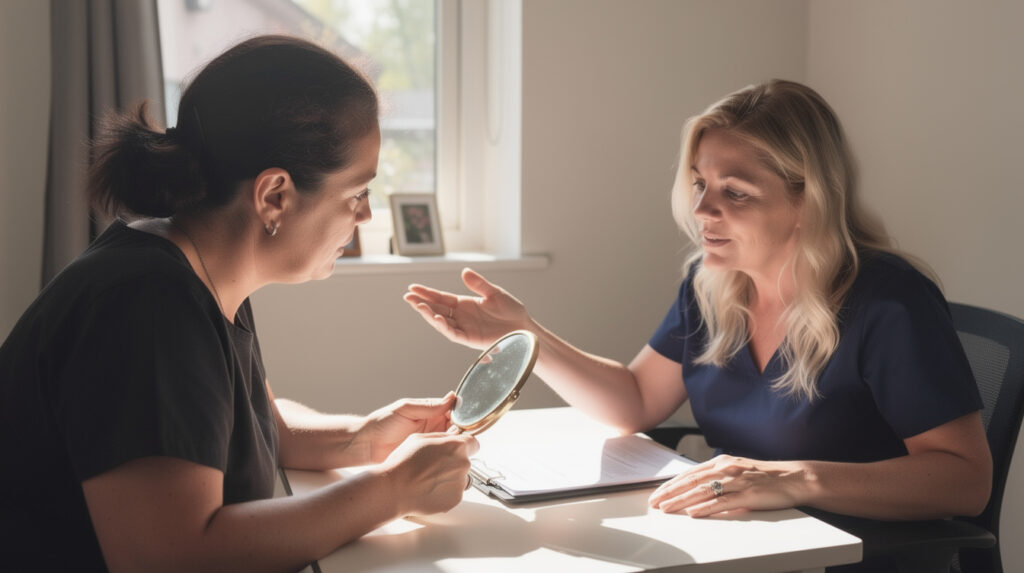
I use scalp micropigmentation as a non-surgical density solution for women with alopecia areata. The treatment adds tiny, hair-like pigment impressions within and around affected areas, blending with existing hair to reduce contrast between growth and loss. This creates a fuller-looking scalp and a subtle, natural density effect without shaving the hair.
Alopecia areata affects countless women, creating patchy areas of hair loss that can feel difficult to conceal and even harder to come to terms with. At The Micropigment Studio, I work with women to address these challenges using scalp micropigmentation — a non-surgical density solution that works with your existing hair. If you are living with alopecia areata, SMP may offer you a genuine path to renewed confidence.
Understanding alopecia areata and its impact on women
Alopecia areata is an autoimmune condition in which the body’s immune system attacks hair follicles, producing irregular patches of hair loss across the scalp. It can develop gradually or appear suddenly, often with no clear warning.
For many women, hair is deeply tied to identity, self-expression, and cultural significance. The emotional weight of patchy thinning can be considerable — affecting how a woman feels at work, in social settings, and in her daily life. Seeking treatment for patchy hair loss is not vanity; it is a practical response to a real and often distressing experience.
While causes vary, the condition is unpredictable and conventional treatments do not always deliver consistent results. This is where SMP as a density solution can make a meaningful difference.
What female density SMP involves
The SMP approach I use for women with alopecia areata is specifically designed as a density addition — meaning your hair does not need to be shaved. This is a critical distinction, and one that matters enormously to the women I treat. Using refined micropigmentation technique, I deposit tiny, hair-like impressions of pigment at scalp level within and around the affected areas.
These impressions blend seamlessly with your existing hair, reducing the visible contrast between areas of growth and areas of loss. The result is a more uniform, fuller-looking scalp that reads as natural density rather than obvious intervention.
Each session is tailored to your specific pattern of hair loss. Because alopecia areata patches vary in size, shape, and location from woman to woman, I work closely with each client to map out which zones need attention and what degree of pigment depth will create the most realistic outcome.
Why SMP is well-suited to patchy hair loss in women
One of the most common concerns I hear from women exploring treatment for patchy hair loss is that they do not want anything dramatic or obviously cosmetic. SMP for alopecia areata addresses this directly — when performed with care and precision, the result is subtle and convincing.
Because the affected zones do not need to be shaved, your existing hair continues to provide natural coverage and texture above the pigmented layer. The SMP works beneath and between the hair strands, adding the illusion of density rather than replacing what is missing.
My background spans decades of paramedical and cosmetic micropigmentation, including advanced permanent makeup, microblading, and SMP certifications from Scalp MicroNation and ScalpCo Academy. That depth of experience matters when treating a condition as nuanced as alopecia areata, where precision and colour-matching are everything.
For women who have tried topical treatments or other options without satisfying results, SMP as an alopecia density solution offers something different — a cosmetic improvement that is visible immediately and does not depend on the unpredictable nature of hair regrowth.
What to expect when you come to Micropigment Studio
When you book a consultation at Micropigment Studio in Willow Glen, San Jose, we begin by discussing your hair loss history, the areas you would like addressed, and your expectations for the outcome. I take time to understand what matters most to you before any work begins.
Sessions are typically calm and comfortable. I use a gentle technique suited to the delicate nature of female density SMP, working carefully to ensure pigment placement looks natural from every angle. Most women require more than one session to build the desired level of density, and I will guide you through that process with honesty.
Micropigmentation has been my passion for well over three decades. Helping a woman look in the mirror and feel like herself again — that is the outcome I work towards every time.
Frequently Asked Questions
Does SMP for alopecia areata require shaving my head?
No. The female density SMP approach used at Micropigment Studio does not require you to shave your hair. Pigment is applied at scalp level to blend with your existing hair, creating the appearance of greater density in areas affected by alopecia areata without any need to remove the hair you have.
Will SMP look natural on patchy areas caused by alopecia areata?
Yes, when performed with precision and careful colour-matching, SMP blends naturally into the scalp and existing hair. The treatment for patchy hair loss works by mimicking the appearance of hair follicles, reducing the contrast between bare patches and areas of growth for a convincing, understated result.
How many SMP sessions will I need?
Most women require two to three sessions to achieve their desired density. The exact number depends on the extent of the alopecia, the size of the affected areas, and the level of coverage you are looking for. Each session builds on the last, and I will advise you throughout the process.
Can SMP be applied if my alopecia areata is still changing?
This is something we discuss thoroughly during your consultation. Because alopecia areata can be unpredictable, I assess your current hair loss pattern before proceeding. SMP can still provide a meaningful alopecia density solution even in active cases, and touch-up sessions can address any changes over time.
Is the SMP procedure uncomfortable?
Most women find the procedure very manageable. Sensation varies depending on scalp sensitivity and the areas being treated, but the process is generally well-tolerated. I work at a pace that keeps you comfortable throughout, and any mild tenderness typically settles quickly in the hours following your session.
How does SMP work for alopecia areata?
I deposit tiny, hair-like impressions of pigment at scalp level within and around areas affected by alopecia areata. These impressions blend with existing hair and reduce the visible contrast between areas of growth and loss. The result is a more uniform, fuller-looking scalp that reads as natural density rather than obvious intervention.
